| Oops, an error occurred! Code: 2023122020564589ce5eb1 |
| Oops, an error occurred! Code: 20231220205645ab0f0273 |

Dear All,
Before most of you will leave the offices in July/August I would like to inform you about latest happenings and upcoming dates of UEF. The autumn will bring an interesting development of historic dimension that will certainly add work to UEF: For the first time we will have the European Parliament co-deciding on the (real) EU-Budget and before end of the year the EU will have its External Action Service in place. Please keep in mind that the UEF Office is closed during August. We will keep you informed about all this. Enjoy the summer and the next days where we will have a Worldcup Champion from the European Union! Sincerely yours, Christian Wenning UEF Secretary General UEF NEWSClosing of the UEF office
Due to the European Union’s traditional summer long close-down period and Brussels getting emptier, UEF Secretariat in Brussels will be closed from 28th of July – 27th of August. Enjoy your holiday and see you all in September!
NEWS FROM SECTIONSEuropa-Union Deutschland: “Europe 2020 – a critical evaluation of the new EU strategy”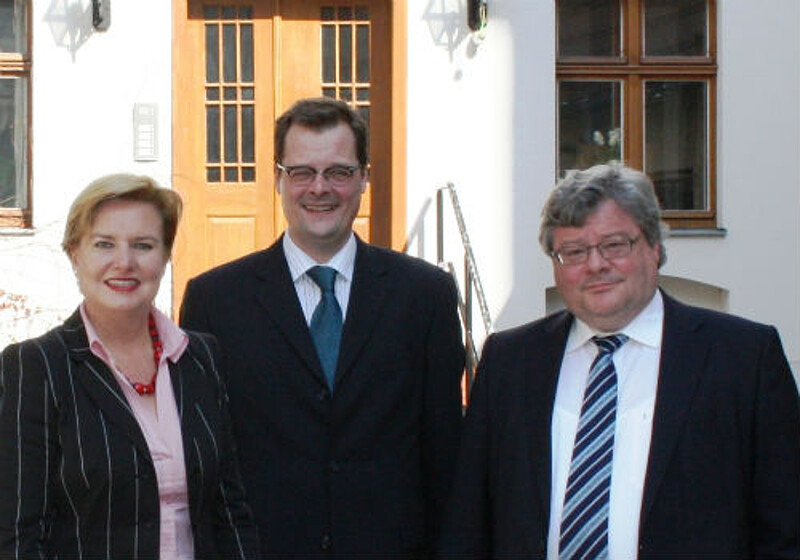
On June 17th in Berlin. The European Council adopted the Europe 2020-Strategy, wishing to pave the way for “intelligent, sustainable and integrative growth” in the European Union. The agenda for growth and employment is supposed to replace the largely failed Lisbon Strategy and to create “a vision of Europe's social market economy for the 21st century”, according to Commission President Barroso.
Reinhard Bütikofer MEP, Dr Eva Högl (member of the Bundestag) and Dr Joachim Wuermeling, all board members of the Europa-Union Deutschland (UEF Germany), published a critical evaluation of the EU strategy which can be found at http://www.europa-union.de/index.php?id=5801. Press Release: Parliamentary Groups of the U.E.F. Germany commend German Bundestag for using new competences, call for further involvement in European policy-making
A year ago on June 30th, the Federal Constitutional Court of Germany delivered its judgment on the Treaty of Lisbon, declaring it to be in principle compatible with the Grundgesetz while at the same time calling for a stronger role of the Bundestag in European policy-making.
On the one-year anniversary of the judgment, the Parliamentary Groups of the Union of European Federalists Germany in the Bundestag and the European Parliament issued a joint press release. Dr Eva Högl, Dr Günther Krings, Michael Link and Manuel Sarrazin, all members of the Bundestag, and Alexander Alvaro, Michael Cramer, Matthias Groote and Joachim Zeller, all MEPs, commend the Bundestag for making good use of its new rights regarding EU matters. They call on their colleagues in the Bundestag to actively engage with European policy-making processes and to support an open, transparent and regular dialogue with associations and civil society. They argue that strong and confident parliaments which participate in debating and deciding European matters are the only way to bring Europe closer to its citizens, and therefore call for a further Europeanization of the Bundestag. Full text (in German): http://www.europa-union.de/index.php?id=6117. UEF Groupe Europe MeetingOn 28th of June UEF Groupe Europe met to review actions and define future activities. A follow up was considered to the Public Conference of 2 June on the EEAS with the two EP rapporteurs, Elmar Brok and Guy Verhofstadt, to be confirmed in September. Groupe Europe was part of the group of Federalists that met with the presidents of EP political groups on 10 June, for a TV programme jointly cast by EuroParlTV and Euronews; it will try to pursue the dialogue that was engaged with UEF Belgium, on the basis of questions that could not be put to the MEPs. PAST EVENTSUEF Seminar in Prague: "The Economic Union without political?"
On 24th of June Union of European Federalists (UEF) and the European Movement in Czech Republic organised a discussion. The main lecturer was the chief EU Affairs Economist of one of the biggest banks in the Czech Republic and Member of Adviser Committee to the EC in Economic Affairs Mr. Petr Zahradnik whose main goal was realistically describe today’s economic, monetary and fiscal situation within the European Union accumulating debts instead capital.
Should the economic union enhance the political one, respectively what is the right measure of cooperation among member states - common economic and fiscal policy or harmonised or only coordinated? Finalising the discussion conclusions on how to ensure the effective process enabling Economic Union realisation were made: 1) Sustainable fiscal discipline creation within the EU territory; 2) Rules harmonisation of fiscal (tax and expenses) policy among member states; 3) Coordination of ex-ante budget processing for one-year as well as three-years periods; 4) The establisment of a special EU authority for the budget surveillance; 5) New budget structure adapted to new circumstances and new division of competences among local, regional, national and the EU levels - The Adapted Fiscal Federalism is becoming a reality. Federal Union: Is the eurozone working? Lessons from the Greek crisis
On 24th of June the Federal Union (UEF UK) together with Federal Trust and Global Policy Institute organised a seminar on “Lessons for Europe from the Greek crisis” held at London Metropolitan University in London.
With the participation of leading EU experts economic commentator Graham Bishop, former European editor at the Guardian John Palmer and professional Research Fellow at SOAS George Irvin, a seminar discussed the lessons what caused the sovereign debt crisis enveloping Greece and other countries in Europe and how can they get out if it again? To read a report on the seminar visit Federal Union’s website at http://www.federalunion.org.uk/news/2010/100630lessonsfromGreece.shtml. JEF and UEF Germany Parliamentary Group: One year after the Lisbon-Judgment of the German Federal Constitutional Court. Debate on the new role of parliaments at the “Parliamentary Forum Europe’s Future”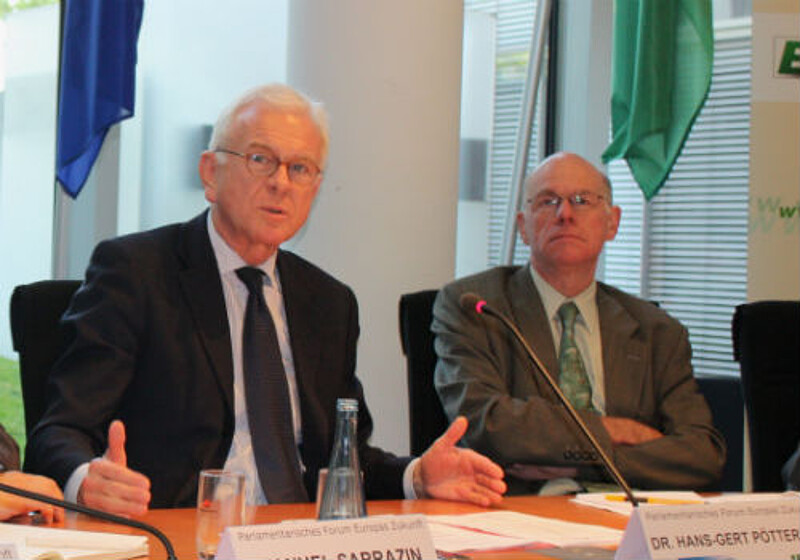
29th of June in Berlin: The Treaty of Lisbon not only strengthened the co-decision powers of the European Parliament but also expanded the role of national parliaments in EU matters. For Germany, the judgment of the Federal Constitutional Court of June 30th, 2009 led to a further strengthening of the Bundestag: due to extensive information and participation rights Parliament today has a rather strong position regarding European integration in Germany.
In order to discuss the new role of the Bundestag and the European Parliament, the Parliamentary Group of the UEF Germany and the Young European Federalists Germany (JEF) organized a Parliamentary Forum with Norbert Lammert, President of the German Bundestag, and Hans-Gert Pöttering, former President of the European Parliament. Speaking about the newly established subsidiarity checks, Norbert Lammert called on the national parliaments to use their new instrument with care but also with confidence. Hans-Gert Pöttering criticized the Lisbon-judgment of the Constitutional Court for failing to take the sui generis-character of democracy on the EU level into account. Pointing out the different standards that European politics were often judged with, he warned of Europe becoming a scapegoat for discontent with national politics. http://www.federaleurope.org/uef/news/alain-lamassoure-a-case-for-an-optimistic-federalism/ FUTURE EVENTSCall for participants: EMI Training Academy (13-19 September 2010)
The EMI Training Academy – Summer School is a high-level, tailor-made training course on the workings of the EU institutions and on programmes available to university students.
The European Movement International, with its growing network of 42 National Councils and 27 International member associations across Europe has direct access to professionals of the EU structure at all levels, making the EMI Training Academy the perfect tool for students who want to pursue a career in EU affairs, or who want to perfect their knowledge of the EU. During the one-week course, students meet with officials from the EU institutions, professionals from European civil society organisations and consultants based in Brussels, in a relaxed and friendly atmosphere. Target group: University/PhD students or recent graduates who have a strong interest in European affairs. Students will be selected according to the following criteria: • Fluency in English – the training will be in English • Good knowledge of the EU • Motivation To register or for more details, please send an e-mail to mljacquemin(at)europeanmovement.eu. The EMI will confirm your registration by 23 of July. |
|
Union of European Federalists (U.E.F.) European Secretariat, Square de Meeûs 25, B - 1000 Brussels Tel: +32 (0)2 508 30 30 | info@federalists.eu | http://www.federalists.eu |