The federalist cloud in the post-war period
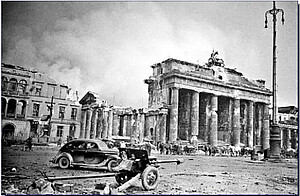
In the 1930s, the inability of the inter-governmental League of Nations to deal with the growing threat of war led to the conviction that peace could best be preserved by means of a world-wide inter-state federation. Building a new inter-state system—namely a European federation—seemed to many to be the obvious way forward. To this end a federalist group [MFE] was formed in Italy in 1944. The following March a ‘Conference on European Federation’ was held in Paris with Albert Camus as its opening speaker. And other meetings followed.
The federalists’ impact in shaping Europe
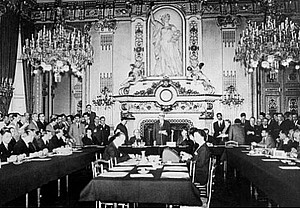
The decade following the Second World War has been decisive for the shaping of the new, pacific Europe. Speaking in Zurich, 1946, Winston Churchill proclaimed that ‘the safety of the world requires a new unity in Europe’. He proposed “a kind of United States of Europe”. At the same time an international federalist group was at work in Hertenstein [Switzerland] on a federalist model for our continent’s future [LINK]. In 1950, Robert Schuman launched the Coal and Steel Community inspired by federalists principles and aiming to lead, in the long run, to a ‘European Federation’.
Altiero Spinelli, EU founding father and well-know federalist
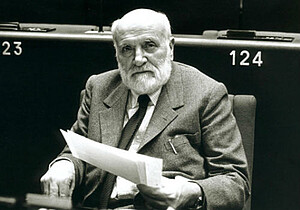
As a young student Spinelli was imprisoned on the island of Ventotene by Mussolini’s fascists. There he was introduced to federalism by some books smuggled in for him by the publisher Luigi Einaudi. Together with his fellow prisoner Ernesto Rossi he wrote a federalist manifesto entitled Toward a free and united Europe, the Ventotene manifesto, considered as a founding document for today’s Europe. After he was released from imprisonment, he worked to establish the Movimento Federalista Europeo [MFE] and played a leading role in creating the Union of European Federalists.
The setting up of the Council of Europe and the European Convention on Human Rights
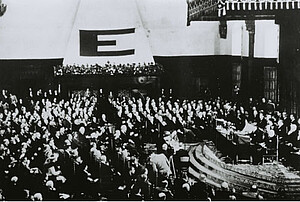
At the Congress of Europe, held in The Hague in 1948 and chaired by Winston Churchill, federalists struggled to put over their vision of Europe’s future.The immediate outcome was after all not a federation but the inter-governmental Council of Europe with a parliamentary Assembly whose members were drawn from member states’ parliaments. Yet important federalist elements were also agreed, such as the decision to draw up a binding Charter of Fundamental Human Rights and the establishment of a supra-national Human Rights Court. Today a state applying to join the EU must first become a member of the Council of Europe.
The decisive influence of federalists on the creation and adoption of the Single European Act
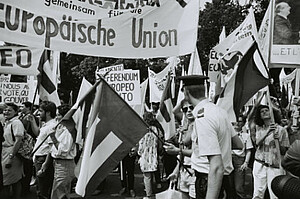
Supported by the UEF, Altiero Spinelli persuaded the elected European Parliament to agree its own text for a Draft Treaty for a European Union [1986]. This draft, renamed the Single European Act, formed the basis of that year’s inter-governmental discussions in Milan. As at previous ‘summits’ the UEF organised a mass street demonstration, this time calling on the heads of government to support the Single European Act. An estimated 200,000 people took part—the largest ever!
A directly elected European Parliament, a federalist cause
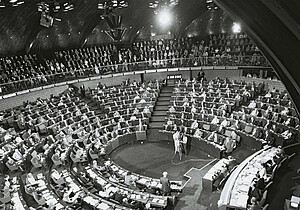
The EP -previously Assembly- originally consisted of selected members of member states’ parliaments. At that time it exercised only ‘supervisory’ powers but pressure from the UEF and other federalist organisations led to MEPs now being directly elected using a common electoral system. Thanks to the popular legitimacy suffrage bestows, the EP kept on gaining influence in the EU system. It now has extended powers allowing it to propose amendments to draft legislation, to interview potential EU commisssioners, and to monitor the EU budget. Meanwhile federalists continue to campaign for a further reform of the European Union’s democratic structures and a more direct link between the EP and its citizens.
The Maastrciht Treaty and the birth of the ‘Political Union’
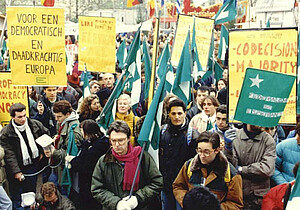
Maastricht was crowded with federalists from the UEF and the YEM youth movement while the heads of member states’ goverments negotiated the Treaty on European Union [1992]. A meeting of several hundred addressed by the Commission President Jacques Delors among others was followed by a march back to the town centre; and the same evening the young federalist movement held an impressive torchlight procession shown on TV news bulletins throughout Europe. The Treaty contained many federalist elements including the introduction of an EU citizenship with the right to free movement thoughout the Union, increased European Parliament powers, initiated a single European currency and monetary union. It also covered environmental protection and human rights.
A European Central Bank, a federal tool

Following work by federalist working groups the European Central Bank in the EU was established to ensure monetary stability through the convergence of member states’ economic performance, their national budgets and currency exchange rates. At present federalists moot for a more important role of the ECB.
The European Union Citizenship

Introduced by the Maastricht Treaty, the EU citizenship was in many ways a federalist achievement. Already in the European Coal and Steel Treaty [1951] mobility of labour and the need for the protection of workers’ rights were recognised but not political or other citizenship rights. Proposals from working groups in both the UEF and the International European Movement influenced the Maastricht negotiations and led to the introduction of an EU citizenship bringing with it the right to vote in local and European elections in whichever member state the person concerned is legally resident.
The Schengen area, a federalist fight
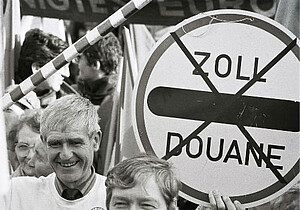
Consisting of those EU states which have agreed to abolish all immigration and customs controls at land borders with other EU members, the Schengen area fulfills the dream which motivated an international group of young federalists back in 1950. Gathering peacefully at the Franco-German border near Strasbourg they demonstrated their wish to see a united Europe by ceremonially burning the wooden barriers at the frontier post. It was not until 1986 that most but not all EU ministers met in the Luxembourg village of Schengen to sign the ‘Accord’ to scrap their border posts.
The Treaty establishing a European Constitution
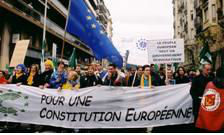
This highly simbolic text was supported by the UEF despite what federalists regarded as its limitations. It aimed to make the European project more citizen-friendly and to set guidelines for its future development. Despite its positive features and the active support of federalist groups it was defeated in a referendum in France followed by a further defeat in the Netherlands and therefore had to be abandoned.
Federalists for the Lisbon Treaty

Taking on board the democratic improvements of the defeated Constitutional treaty, the Lisbon Treaty had the support of the federalists. Pro-eminent federalists mooted for it despite its limitations. Notably, during the ratification process the Young European Federalists sent a pen to the Czech president Klaus, who hampered the ratification process, encouraging him to sign off the Lisbon Treaty without delay.