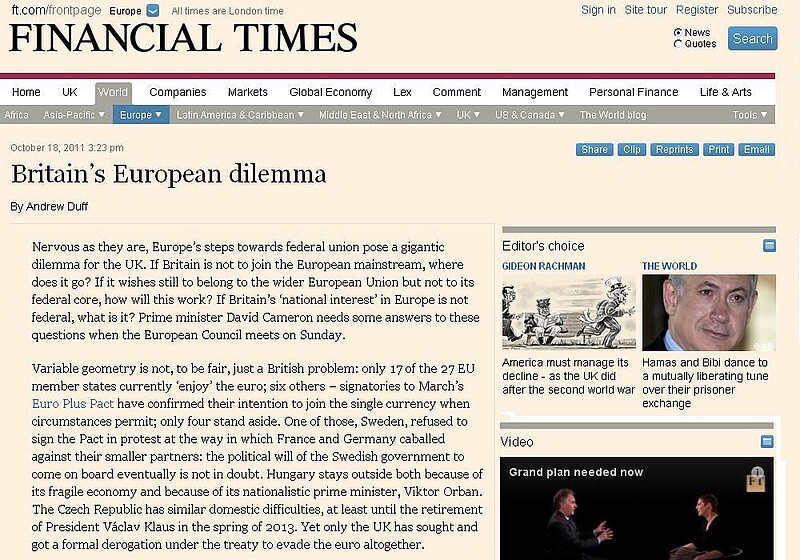
"Nervous as they are, Europe’s steps towards federal union pose a gigantic dilemma for the UK. If Britain is not to join the European mainstream, where does it go? If it wishes still to belong to the wider European Union but not to its federal core, how will this work? If Britain’s ‘national interest’ in Europe is not federal, what is it? Prime minister David Cameron needs some answers to these questions when the European Council meets on Sunday.
Variable geometry is not, to be fair, just a British problem: only 17 of the 27 EU member states currently ‘enjoy’ the euro; six others – signatories to March’s Euro Plus Pact have confirmed their intention to join the single currency when circumstances permit; only four stand aside. One of those, Sweden, refused to sign the Pact in protest at the way in which France and Germany caballed against their smaller partners: the political will of the Swedish government to come on board eventually is not in doubt. Hungary stays outside both because of its fragile economy and because of its nationalistic prime minister, Viktor Orban. The Czech Republic has similar domestic difficulties, at least until the retirement of President Václav Klaus in the spring of 2013. Yet only the UK has sought and got a formal derogation under the treaty to evade the euro altogether.
The federal core which is needed to save the euro means inevitably a less engaged periphery. The outcome will be not just a two-speed Europe, which we have had for years, but a two-tier Europe in which the UK is in a minority pursuing different objectives. How will the EU cope with such accentuated divergence between the ins and the outs?
José Manuel Barroso, president of the European Commission, understands the problem. In his recent State of the Union speech to the European parliament Mr Barroso laid out a skilful five-point road map for salvaging the eurozone and laying the basis for economic recovery. He proposes to integrate the Euro Plus Pact into the regime of the European semester which empowers the Commission to survey and verify national budgetary policies, with coercive preventive and corrective instruments when things go awry. The twin goals of the Pact are to foster competitiveness and employment, and to reinforce the stability and sustainability of public finances. So if the Council and parliament agree with the Commission, the Euro Plus Pact will graduate from a voluntary code of conduct into enforceable EU law.
In his quest to complete the single market programme, Mr Barroso commits to using the enhanced co-operation clauses of the Treaty of Lisbon to allow a core group to integrate further and faster than all 27 states would wish to do. Such a group could well be formed in matters of fiscal policy by a qualified majority decision of the Council against which the UK no longer has a veto. (When new voting rules come into force in November 2014, the UK will find it even more difficult to build a blocking minority.)
Other elements of stronger economic governance include a clear hierarchy and tight co-ordination between formal summit meetings of the eurozone heads of government, finance ministers sitting in the eurogroup formation and the euro area working group. These reforms will provide the Commission and the European Central Bank with a more disciplined and functional interlocutor. New legislation for the eurozone (under Article 136 TFEU) will attach greater conditionality to the use of the European financial stability facility and its successor the European stability mechanism (whose creation will be speeded up and capability enhanced).
All that – ‘more discipline, more integration ... more Europe’, as Mr Barroso puts it, can be done under Lisbon, but not much else. Article 122 allows the EU to offer financial assistance to a state in trouble only in an acute emergency. Article 125 forbids the mutualisation of sovereign debt. Therefore any permanent system under which EU states share their collateral needs treaty change, as does the launching of eurobonds (or ‘stability bonds’), the establishment of a European Monetary Fund as a debt agency, and the installation within the Commission of an EU treasury secretary.
Mr Barroso is keen to ensure compatibility between the euro area and the Union as a whole. Indeed, that is his job. He believes, rightly, that keeping the Commission, the parliament and the European Court of Justice at the heart of the integration process will guarantee a certain cohesion among all member states which would otherwise be lost. Yet the European Council of heads of government is about to divide itself into two formal groupings. Pressure will increase also to split up the Council of Ministers, where law is made. Can one chamber of the legislature be divided while keeping unitary arrangements in the other legislative chamber? The active role of some British MEPs in economic and monetary affairs is already being questioned, as it is in justice and home affairs, where too the UK government is only a semi-detached player.
British ministers are being none too helpful. At a Friends of Europe conference in Brussels last week the UK was accused of ‘talking to the EU like the Americans’. George Osborne talks of the ‘remorseless logic of fiscal union’ for the eurozone without appearing to notice the possible consequences for the UK when federal economic government is installed to manage and direct that fiscal union. Most Tory MEPs voted (with the socialists) against the recent legislative ‘six pack’ which strengthens the Stability and Growth Pact and lays important foundations for rebuilding market and democratic confidence.
Nick Clegg rightly stresses the importance of sustaining the single market at all costs, but he knows well enough that Europe is not built on the market alone. In the interests of his own party’s differentiation, at least, Mr Clegg should now press for the UK to sign up to the recast (and renamed) Euro Plus Pact.
Unless the coalition government emits more positive signals, the parting of the ways between Britain and Europe will become unstoppable. Even Poland, the current presidency of the Council of Ministers, courted in vain by William Hague, has organised an initiative with France, Germany, Italy and Spain to push forward alone on common security and defence policy. It had long been taken for granted that nothing could happen in the EU on defence without the UK. Not so now.
The current British debate about human rights is followed closely on the continent. The UK’s apparent neglect of the EU Charter of Fundamental Rights is regretted, as is its very recent attempt to derail the negotiations between the EU and the Council of Europe, which would join the Union to the European Convention on Human Rights and afford the Court of Justice a much larger role in rights law.
Bashing the Luxembourg Court is not a sensible line for the Brits. One day they may well need to have recourse to it to protect the sovereign rights of the UK as a full member state of the EU.
The peril of European disunity is high. Deep reflection is needed by all concerned before irrevocable decisions are taken. Remorselessly logical it may be, but treaty change is delicate. On Sunday, David Cameron would do well to encourage his colleagues in the European Council to accept Mr Barroso’s suggestion that a group of wise persons is established to ponder further Europe’s future constitutional arrangements.
Andrew Duff MEP is President of the Union of European Federalists. His latest publication is Federal Union Now."
View the original article on the Financial Times website.
19 October, 2011
"Britain’s European dilemma", Andrew Duff's latest article on the Financial Times
At a time when the European Union has to address difficult challenges, the United Kingdom is very reluctant to progress towards a federal union. Andrew Duff gives his thoughts on the question of the place of the United Kingdom in the EU in an article on the Financial Times, which you can read below.